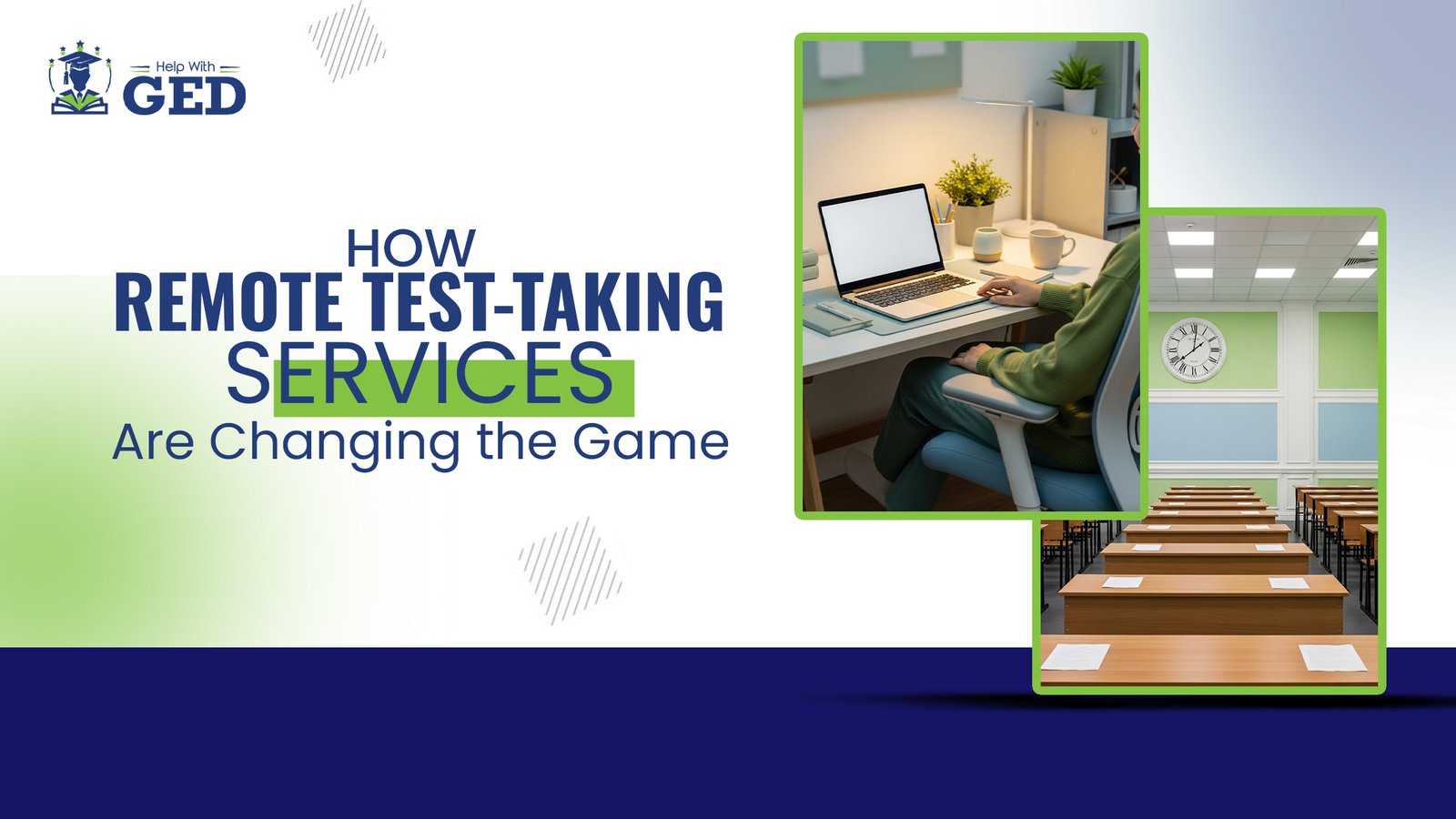
How Remote Test-Taking Services Are Changing the Game
Education has always been a large component of exams. However, this is no longer the case, as the way we administer tests is evolving. Remote proctored exams are facilitating students to demonstrate their competency anywhere because of digital learning. Remote testing has enabled exam-taking to be convenient, secure, and flexible to learners across the board, whether it is a college assessment or a GED exam help session.
This blog discusses how online exams are changing education, why they are secure, and why they are defining the future of testing.
Why Remote Testing Is Revolutionizing Exams Today
Students previously were forced to visit testing centres. Remote testing has now enabled exams to be taken at home, at school or even on the go. The system implements the use of webcams, microphones and intelligent software to observe test takers in real-time.
Accessibility is the primary factor that is causing remote proctored exams to become popular. Remote or rural students are now able to undertake key exams without any concern for either the cost of travelling or time constraints. Besides, it allows working adults or parents to do their certification, such as the GED, at their own pace. This is a flexible method that makes exams fair, reliable and efficient, no matter where you are.
The Rise of Remote Proctored Exams: What You Need to Know
During the growth of digital classrooms, remote proctored exams have emerged as a reliable option for schools, universities, and certification authorities. These tests are both technological and human-supervised to guarantee integrity and equity.
The proctoring tools are used to check the identity of a student, screen activity and also eye movement. This will help avoid cases of cheating and will give the institution confidence in its performance.
A lot of online education courses, as well as high school equivalency exams, are now being based on remote supervision systems. As an example, students training to take their GED tests will find it easy to discover how a remote online proctored exam can help them test more safely and conveniently.
Remote Proctoring Explained: From AI to Human Supervision
Remote proctoring can happen in several ways. In some exams, artificial intelligence (AI) tools automatically monitor students. These systems detect suspicious movements, background noise, or multiple screen activities.
In other cases, human proctors watch students live through webcams. The combination of AI and human observation ensures accuracy and reduces errors. It’s a balance between efficiency and fairness, making remote proctored exams both smart and secure.
This blended method is becoming a standard part of educational assessments around the world.
The Technology Powering Secure Remote Tests
Internet security and sophisticated software are the basis of online testing. The Facial recognition, screen tracking and data encryption assist in ensuring the safety of exams. The student’s identity is checked by the system before the test, and the AI monitors behaviour throughout the test.
Cloud servers will also ensure the confidentiality of exam data and prevent tampering. This technological application has not only enhanced a greater degree of reliability but also created confidence in the online test-taking platforms that are in place in schools and institutions around the world.
Unlocking the Benefits: Why Online Test Taking Platforms Matter
Online test taking platforms offer numerous advantages to both students and educators. First, they reduce logistical challenges like travel and printed materials. Second, they provide flexibility—students can schedule exams at convenient times.
Teachers and organizations also benefit from automatic grading and analytics. These insights help improve future assessments. Moreover, such systems promote inclusivity, allowing students with disabilities to use assistive tools or extra time options.
This growing trend reflects a clear shift in the education system toward comfort, speed, and equal opportunity for all learners.
Facing the Challenges: Security, Privacy, and Tech Hurdles in Remote Testing
Remote testing has its own peculiarities, although it has numerous advantages. Test security in remote exams, privacy of data, and technical problems are also of concern. These are some of the issues that need to be understood and resolved to ensure that the integrity of exams is upheld.
Battling Cheating: How Test Security Is Evolving
One of the most talked-about issues in remote exams is cheating prevention. Smart cameras, motion tracking and browser lockdown are the features that are used in the systems to prevent dishonest behaviour.
The proctors are also trained to identify suspicious behaviour, such as the student gazing around too much or using an external device. AI systems put a red flag on such actions immediately. This will make sure that the remote online proctored exam sessions are fair and credible to all parties.
Overcoming Tech Glitches and Connectivity Issues
One of the big issues facing students is the stability of the internet. Disruptions may bring about stress and performance issues. To manage the same, the majority of testing platforms incorporate automatic reconnection.
It is also recommended that the students test their gadgets in advance and find a quiet place. The exams are also attended by the technical support teams to correct problems promptly. More reliable and less stressful, remote exams are becoming more and more reliable with each update due to technology.
Protecting Privacy in a Digital Exam World
Another significant issue in the area of digital testing is privacy. These remote systems capture personal information, including webcam shots and ID checks. Accountable platforms are compliant with privacy policies and encryption techniques to secure student data.
The institutes need to reveal information on what is being captured and the time period. This creates confidence between students and academic institutions, and the testing process becomes safer.
How the GED and Other Major Tests Are Embracing the Remote Revolution
Major educational tests, including the GED, are quickly adopting online formats. Students can now register, prepare, and take the GED exam from the comfort of home.
If you’re curious about how this process works, check out how does the online GED test works to understand each step from registration to scoring.
Remote exams make the GED more accessible to adults who can’t attend in-person test centres. It’s also a major advantage for people balancing jobs, family, or travel schedules.
Future Trends: What’s Next for Remote Testing?
Remote testing is evolving rapidly. As technology becomes smarter, exams will become even more adaptive, secure, and personalized. Here’s what’s coming next in the world of online education.
Smarter Exams with AI and Behavioural Analytics
Artificial intelligence is playing a bigger role in assessment. Future remote proctored exams will use behavioural analytics to study test patterns and detect unusual behaviours.
AI can also provide personalized question sets based on a student’s learning history. This helps measure knowledge more accurately and fairly.
Hybrid Testing Models: Best of Both Worlds
Many institutions are considering hybrid testing—a mix of online and in-person exams. This model combines flexibility with traditional supervision.
Students may take theory tests remotely while completing practical parts at a center. This approach can improve accessibility of remote exams while maintaining high credibility and comfort.
Making Remote Tests Fair and Accessible for Everyone
Accessibility remains a key focus for educators and policymakers. Exam platforms now support screen readers, large fonts, and multi-language options for students with disabilities.
The accessibility of remote exams ensures equal opportunities for all learners, regardless of their physical location or background. This inclusiveness is one of the greatest advantages of digital testing.
Navigating New Rules and Regulations
Due to the increase in online exams, the rules regarding them have also expanded. Governments and school authorities are establishing unambiguous policies about online testing and identity verification, and confirmation.
Such standards assist in the preservation of quality as well as avoiding misuse. Keeping up with new regulations will enable students to move around the evolving new world of remote learning with confidence.
Pro Tips for Test Takers: Mastering Your Remote Exam Experience
To pass remote exams, one needs to prepare and be at ease. Here are a few practical tips:
- Test your internet and equipment before the test.
- Carefully read instructions.
- Make your room as noisy as possible.
- Distractors should be avoided by switching off notifications.
- Training using practice exams to learn the format.
Other tips and efficient ways of preparation can also be learned in Crush The GED Exam With Smart GED Practice Test Tips by students who are planning to take the GED.
Wrapping Up: How Remote Test-Taking Is Transforming Education Forever
The idea of remote exams is not a crisis solution, but it is the future of education. They ensure that learning and evaluation are available to all, regardless of their place of residence.
As far as remote proctored exams are increasing, schools and organizations are able to uphold fairness, flexibility, and convenience to all learners. This strategy defines a new generation of testing that is appreciative of security and inclusivity.
If you’re planning to take your GED, remember that passing the test can open doors to new opportunities. To learn more, check out the benefits of getting your GED and opportunities and start building a brighter future today.
Recent Blog Post

Why Most GED Study Plans Fail and How to Build One That Actually Works?
Discover why most GED study plans fail, common mistakes to avoid, and how to build a realistic, flexible study plan that fits adult life and improves results.
What First-Time GED Test Takers Wish They Knew Before Exam Day
First-time GED test tips, common mistakes to avoid, smart study strategies, and exam day advice to help you pass confidently on your first attempt.

GED Science Made Simple: What You Actually Need to Know to Pass
GED Science made simple: learn what’s really on the test, key topics, common mistakes, and smart study strategies to pass with confidence.

GED After 30, 40, or 50: Is It Ever Too Late to Start?
Thinking about a GED after 30, 40, or 50? Discover benefits, common challenges, and smart study strategies for adult learners to succeed at any age.