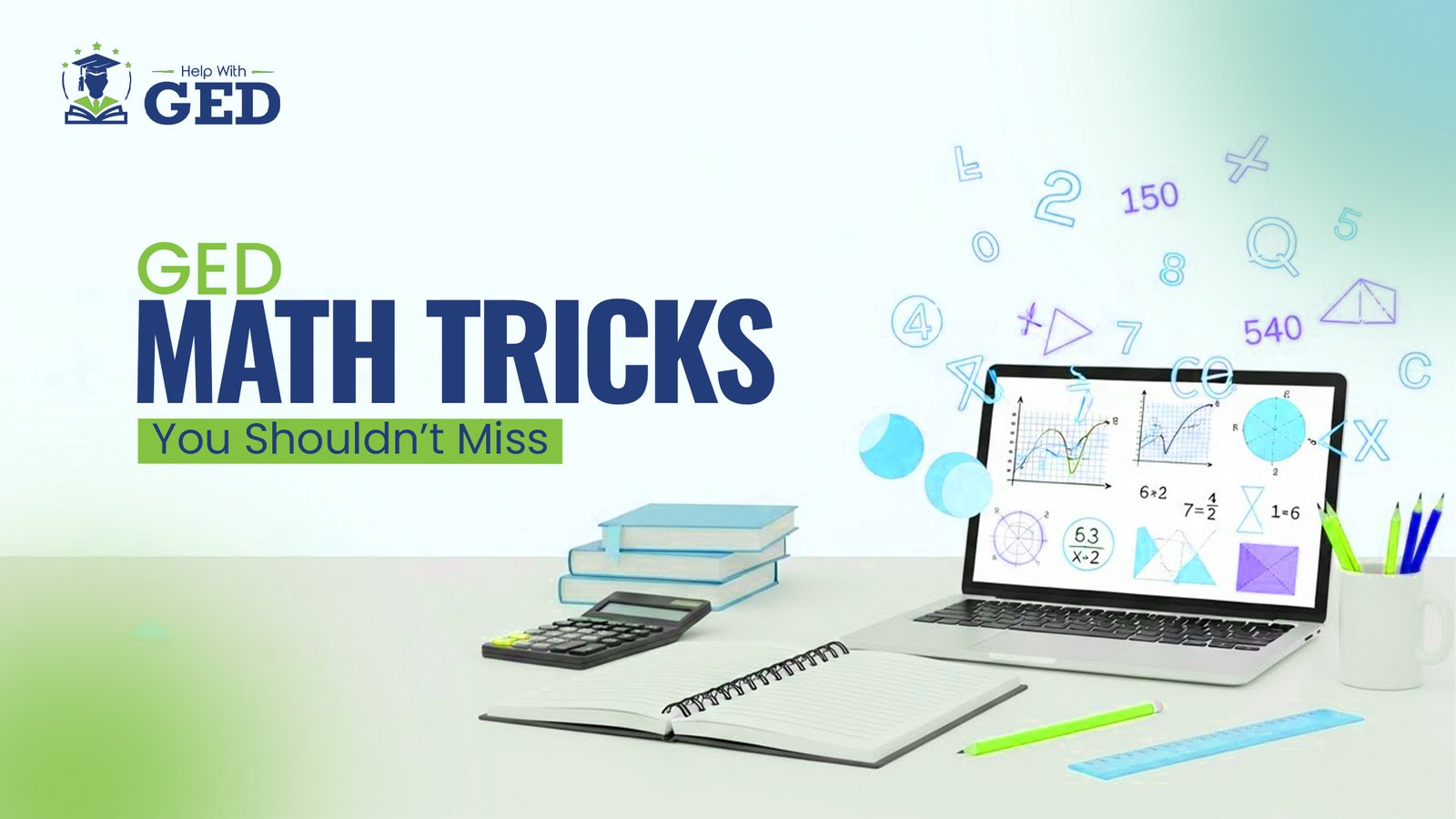
GED Math Tricks You Shouldn’t Miss
The GED Math test measures your ability to apply practical math concepts, not just remember formulas. It is a challenge for many students because of the over-complexity of the subject itself. In addition to that, the pressure of time further makes it even more challenging to tackle. Students look for GED math tips and tricks in order to succeed through this section, as hard work without a smart approach does not work.
According to the GED Testing Service, math is the section with the lowest pass rate, mainly due to weak problem-solving strategies and rushed answers. Even simple math problems start to feel intimidating when you see too many numbers and formulas on the question paper. However, the good news is that GED Math does not demand genius-level skills; it just requires a strategy. You would be able to manage even the most complex equations with the right maths tricks for fast calculation, elimination techniques, and visual tricks. The following post presents you with all the GED math tips that will help you excel in the section.
Why The GED Math Test Trips People Up?
The GED math test includes 46 questions to be solved in 115 minutes, where areas like arithmetic, algebra, geometry, and data analysis are covered. You are allowed to use a calculator for most parts, but not all. Even though the math level is comparable to high school, it is the format and time pressure that make it difficult. The questions involve mixed concepts, making students want to find GED math shortcuts. Many test-takers do not fail because they lack ability, but because they lack strategy and face struggles like;
- Managing a wide range of topics at one go.
- Strict time limit.
- Word problem confusion.
- Formula forgetfulness.
- Over-dependence on the calculator.
- Math test anxiety.
Once you understand these challenges and learn smart problem-solving tricks, the test becomes easy to manage.
GED Math Tips And Tricks For Faster Problem Solving
It is time to give you a peek into some easy math tricks. Begin by understanding that speed and accuracy go hand-in-hand in the GED math test. Students have to learn time-saving techniques and understand how to think strategically. You don’t have to master every math topic; just focus on learning problem-solving patterns with steps like;
Elimination Strategy For Multiple Choice Questions
Mastery learning is not about perfection; it’s about strategy.– Benjamin Bloom
One of the most powerful yet easy math tricks is the process of elimination. Even if you are unsure about the exact solution, you can remove two or three wrong answers by spotting errors or impossibilities.
Elimination also helps when checking for logic. If you plug a value into an equation and the result does not fit the question’s condition, move on to the next. Sometimes you will be left with one or two reasonable choices, greatly improving your odds of getting it right. Elimination keeps your mind sharp and prevents careless mistakes.
Mental Math Hacks That Save Time
Mental math can turn time-consuming questions into quick wins. Start by memorizing basic squares and common fraction-decimal equivalents. These small details can help you verify answers instantly. One of the effective maths tricks for fast calculation is to break big problems into smaller ones and then find the answer.
Another mental shortcut is rounding. Suppose the question asks for an approximate answer; round numbers to the nearest tens or hundreds to estimate quickly. This is especially useful in word problems that involve money, distance, or population.
Still wondering how to pass GED math? Practicing mental math daily, even for five minutes, can enhance your calculation speed and confidence. Remember, the GED is not testing how long you can think; it is testing how effectively you can solve.
When And How To Use The Calculator Wisely?
The GED Math test allows you to use the calculator, but depending on it too much can actually slow you down. The trick is knowing when it is worth using.
Use your calculator for problems that involve decimals, fractions with large numbers, or complex percentages. However, for simple arithmetic, like adding or subtracting round numbers, mental math is faster.
Always double-check your calculator entries. Many students lose points by accidentally typing a wrong digit. Students who often ask how to pass GED math test must remember this rule of quickly scanning the screen to confirm their setup.
Finally, learn your calculator’s special functions, like fraction conversion, square roots, and memory recall. These features save time and prevent repetitive calculations. If you are having difficulties understanding calculations, then you can also get GED test help from professionals. They not only guide you through the concepts but also take your exam for you, promising complete accuracy.
Easy Math Tricks For The GED Test You Can Learn Today
You can prepare best for the GED test by practicing more and more for it. The more you practice small and memorable tricks, the easier tough questions become. Many test-takers struggle to recall key facts and formulas under pressure, which is why they often get GED math help from professionals. However, this is not the only option, as you can adopt other tricks as well, like;
There are visual, verbal, and logical shortcuts you can use to remember formulas and interpret diagrams faster. Formula memorization and visual understanding of geometry, plus graphs, are the easiest plus most practical tricks. These areas often make up a large portion of the GED Math test, including;
Memorization Tricks For Formulas And Conversions
Math formulas might look intimidating, but they stick easily with pattern-based memorization. Try using acronyms or short phrases. For example, remember the area of a triangle (½ × base × height) as half of the base’s height.
Connect circle formulas visually, think of (π) as the curve that defines the circle, which will help you remember πr² for the area and 2πr for the circumference. On the other hand, conversions can be easier with practical links, like:
- 1 foot = 12 inches: think, 12 months in a year, 12 inches in a foot.
- 1 gallon = 4 quarts: imagine, a gallon splits evenly into four.
Revisiting these small tricks regularly trains your brain to recall information automatically during the test.
Visual Tricks For Geometry And Graphs
GED geometry and graph questions can look confusing at first look, which makes students want to request professionals to take my GED test for me. You can adopt the practice of visual reasoning to simplify the process. Start by sketching, but don’t completely depend on the given diagram.
Remember that in geometry, shapes sometimes hide formulas inside them. A square is just two right triangles combined; a trapezoid can be seen as a rectangle plus a triangle. Recognizing these patterns helps you recall formulas faster.
Look for trends instead of exact numbers in graphs. Find out if it is increasing or decreasing, where it crosses the axis, etc. This approach saves time and prevents calculation overload.
GED Math Shortcuts You Need To Know
Understanding GED math concepts is important, but at the same time, it is important to spot patterns, simplify fractions, and decode word problems, which can be done through different shortcuts.
These quick strategies don’t replace knowledge; they enhance it. Once you understand the logic behind them, you can answer faster with fewer steps with easy shortcuts, like:
Recognizing Number Patterns
Number patterns are everywhere in the GED test, especially in sequences and algebraic expressions. Recognizing them saves time.
- When you see 2, 4, 8, 16…, you immediately know it is doubling each time.
- Notice repetition for alternating patterns like 5, 10, 5, 10…. Sometimes, the GED tests your ability to spot logical trends, not perform long calculations.
- Look for patterns in algebra, like (a + b)² = a² + 2ab + b². Once you memorize these, expanding or simplifying equations becomes quick and automatic.
Practicing pattern problems improves your instincts, while turning guesswork into confident answers.
Fast Fractions, Percentages, And Ratios
Many students waste precious time converting fractions and percentages. Use these quick conversions instead:
- ½ = 50%
- ¼ = 25%
- ⅓ ≈ 33%
- ⅕ = 20%
Use mental shortcuts for percentage increases or decreases. You can move the decimal one place left to find 10%. Similarly, ratios can be simplified like fractions; like 12:18 reduces to 2:3 by dividing both numbers by 6.
Word Problems: Clue-Based Solving
Word problems are about interpretation, not just math. The key is to spot clue words that reveal operations. Like,
- Total or sum for addition.
- Difference for subtraction.
- Product for multiplication.
- Per for division or rate.
Highlight these words to guide your equation setup. Also, sketch simple visuals for distance, rate, or money problems, as it clarifies relationships instantly. After finishing, always check if your answer makes sense. Clue-based solving keeps you logical and prevents overthinking while turning lengthy text problems into clear math steps.
Where To Get GED Math Help And Practice Resources?
Ready to crush the GED exam with smart GED practice test tips? Besides these shortcuts, there are many resources that can further help you prepare effectively for the test. It is because these tips and test prep go hand in hand.
Start with GED.com, which is the official GED Testing Service website. It offers sample questions, practice tests, and tutorials that match the real exam format. Platforms like Khan Academy and Quizlet also provide topic-based lessons and timed quizzes to strengthen weak areas.
If you prefer structured learning, consider online GED prep classes or a professional platform that offers to take your exam as well as guide you through the concept. They provide personalized feedback and simulate test conditions for real improvement.
Conclusion: Master The Math And Move One Step Closer To Your GED
GED Math success is less about natural talent and more about smart preparation. Anyone can master this section with the right mix of shortcuts, mental strategies, and consistent practice. Each trick saves your time and reduces errors. These strategies don’t just help you pass; they help you understand how math works in real life. So, start practicing these GED math tricks today. You will be able to excel through the GED math section with focus, patience, and the right approach.
Recent Blog Post
Why Most GED Study Plans Fail and How to Build One That Actually Works?
Discover why most GED study plans fail, common mistakes to avoid, and how to build a realistic, flexible study plan that fits adult life and improves results.

What First-Time GED Test Takers Wish They Knew Before Exam Day
First-time GED test tips, common mistakes to avoid, smart study strategies, and exam day advice to help you pass confidently on your first attempt.
GED Science Made Simple: What You Actually Need to Know to Pass
GED Science made simple: learn what’s really on the test, key topics, common mistakes, and smart study strategies to pass with confidence.

GED After 30, 40, or 50: Is It Ever Too Late to Start?
Thinking about a GED after 30, 40, or 50? Discover benefits, common challenges, and smart study strategies for adult learners to succeed at any age.